Psyched Out Tennis
This is a prototype version of a psychological tennis game I've been mulling over for years. At its heart it's a deck-builder. Its emphasis is on focus, confidence and mental balance, with a push your luck mechanic that can lead to victory or despair.
I don't know if it'll end up as a computer game or a 2 player card game. If it becomes a computer game, it'll have career mode, tournaments, grand slams, injuries and so on.
The AI in this version is awful. :)
Looking for feedback on the feel of the game and the ideas, not the presentation.
INSTRUCTIONS FOR PSYCHO TENNIS
Select Play Game, then choose one of three slots. Resume an existing match immediately, or choose New Match and then enter your first and last name and match length: best of three games, one set, best of three sets, or best of five sets. Replacing an occupied slot requires confirmation. Each occupied slot shows both players’ names, the match type, score, and save date. Your slot saves automatically after every completed game; at a game or set result you may Quit to Title Screen. During play, the QUIT button warns that progress since the last completed-game save will be lost. Resuming shows the scoreboard first, then returns to that result. The computer opponent is given a random name. Sets are won by six games with a two-game lead, with a tie-break at 6–6. Call Heads or Tails, then let the toss winner choose to serve or receive. After the winner is announced, select Return to Title to start another game.
## How to play
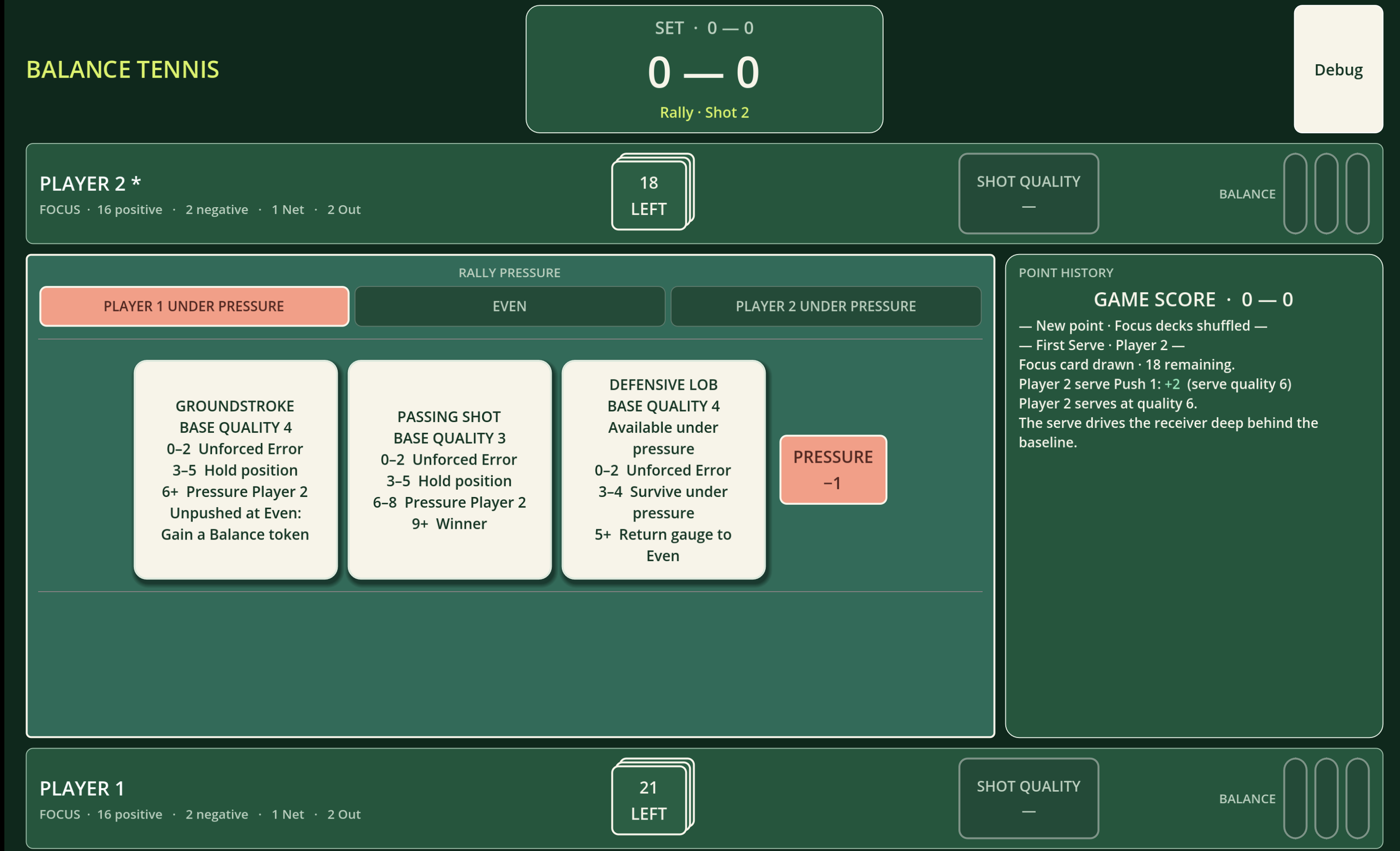
Read the serve announcement then, if you have serve, choose a Serve card. You may Push before pressing Play in order to add Quality to your serve. Every card shows its quality outcomes; low-quality serves are Faults, while low-quality rally shots are Unforced Errors. A second-serve Fault loses the point as a Double Fault.
## Order of events
1. The umpire announces the server and score.
2. Before you choose a serve or rally shot, the computer opponent secretly tries to predict it. For a serve, the possibilities are Wide, Body, or T.
3. You select a card, may Push, then play the shot. The game immediately resolves the opponent’s prediction.
4. Before the opponent returns, you must try to predict the return. The prediction area appears immediately after your shot.
5. The opponent selects and plays their return. The game resolves your prediction, then the opponent attempts to predict your next shot.
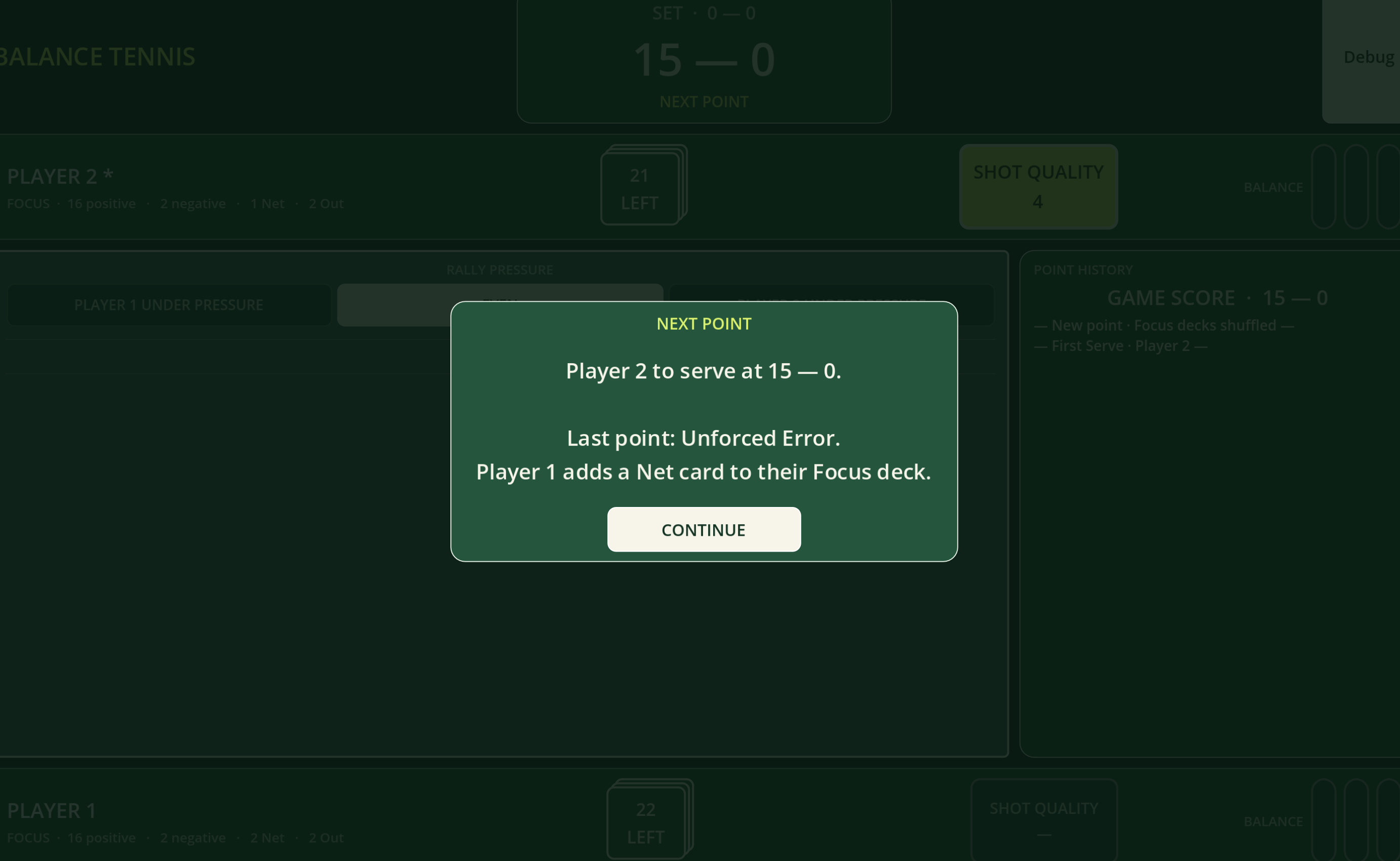
6. Repeat steps 3–5 until the point ends with a winner, error, or double fault. The umpire then announces the next point and any Focus-deck changes.
In short: the opponent predicts your shot → you take it → you predict the opponent’s return → the opponent takes it → the opponent predicts your next return. The prediction display names both the predicted and actual shot. A wrong prediction gives no bonus. READ +1 (which a player gains after a correct prediction) is separate from CONTROL and PRESSURE, and is spent on the next shot the player plays.
There are three serves:
- Wide Serve starts at quality 3. It is safe at 3–4, pulls the receiver wide at 5–7, and is an Ace at 8+.
- Body Serve starts at quality 4. It is safe at 3–5, jams the receiver at 6–8, and is an Ace at 9+. A safe, unpushed Body Serve at Even earns a Balance token.
- T Serve starts at quality 2. Quality 0–3 is a Fault, 4 is safe, 5–6 pressures the receiver, and 7+ is an Ace. You may play it at any quality, including deliberately taking a Fault.
Shot cards depend on the rally state. A Groundstroke is the reliable baseline choice and can earn Balance at Even. A Topspin Drive applies pressure at quality 7 and becomes a winner at 9+, but cannot earn Balance. A Backhand Slice starts at quality 4: at 6+ it applies pressure, or, if you are under pressure, removes one level of the opponent’s Control instead. It cannot win outright or earn Balance. An Approach Shot applies pressure at 5, while a Passing Shot or Volley can attack for a winner. A Defensive Lob is available under pressure: quality 3–4 leaves it short and gives the opponent a Smash opportunity, while 5+ restores Even. A Smash is only available after that weak lob. A Drop Shot is available while in control: quality 0–4 is an Unforced Error, 5–6 lets the opponent reach it and take control, and 7+ wins the point.
## Pressure and Control
Putting the other player under pressure gives you CONTROL +1 and them PRESSURE −1. Sustain that pressure with another strong shot and both modifiers build together: `+2 / −2`, then `+3 / −3`. The red Pressure cards apply to every shot, so a player under pressure must overcome the penalty as well as making their chosen card work. A Defensive Lob can reset the rally to Even.
## Focus decks
Each player has a separate, persistent Focus deck and draw pile. The pile is not shuffled automatically between points or games. At the start of a new serve or shot selection, it is reshuffled only if fewer than three cards remain. Once a player has Pushed during a serve or shot selection, an exhausted pile cannot be reshuffled again until that selection ends. The counter beside each player shows cards left and extra positive and bad cards relative to their starting deck.
- Six +1, five +2, and four +3 cards add to shot quality.
- Two −1 cards reduce shot quality, but do not cause an error.
- One Net and one Out card cause an immediate error.
- One Bad Toss / Wrong-footed card ends any further Pushes for that shot. On a serve it is announced as Bad Toss; the player must serve immediately.
This is a light deck-building system: an Unforced Error or Double Fault adds a random −1, Net, Out, or Bad Toss / Wrong-footed card to that player’s Focus deck. Losing a standard game on your own serve (a break of serve) adds another random bad card; tie-break points do not count as breaks. Serving an Ace, winning a point when either player had game point, or winning a rally of at least seven shots removes one added bad card if available. These rewards do not stack on the same point. If fewer than three Focus cards remain, Push is unavailable until an eligible new selection reshuffles the pile.
Each player can have at most six added positive and twelve added bad Focus cards. If a player would add a card of a category already at its limit, they instead remove a random card of the opposite category from their whole Focus deck. This exceptional removal can take a starter card. No card is removed if the deck has only three cards left or has no card of the opposite category. Ordinary rewards still remove only added bad cards.
At a change of ends, both players make a Focus adjustment. You choose either to add a random positive card or remove one added bad card; the opponent makes the same choice automatically. Both draw piles are then reshuffled for the next end. Draw piles are also reshuffled at the start of a new set, but not simply because a new game begins. An ordinary removal can take an added negative-number card, Net, Out, or Bad Toss / Wrong-footed; only the exceptional overflow rule can remove a starter card.
## Push: power at a price
Push is a gamble for a better shot. It deals three Focus cards face-down, burns the first two, and resolves the third. A number changes the selected shot’s quality; Net or Out immediately causes a Fault or Unforced Error.
You can Push again while at least three cards remain, unless a Bad Toss / Wrong-footed card stops further Pushes. Every Push spends more of the draw pile. A negative-number card reduces only the current shot’s quality; an error that loses the point adds a bad card to the permanent Focus deck.
Balance is the safer counterweight. A safe, unpushed Body Serve or an unpushed Groundstroke at Even earns a Balance token. Complete three tokens to restore Balance: remove one bad card, if present, and reshuffle Focus. The row then resets and can be built again. Tokens carry between points and into the next game only for the player who won the previous game; the player who loses a game loses theirs.
This prototype was vibe coded with OpenAI Codex. All game design by Ian Williams, which is the point.
Development log
- No, it’s Psyched Out Tennis!3 days ago
- Proto Psycho Tennis!4 days ago
Leave a comment
Log in with itch.io to leave a comment.